Logo stings
Bouncing dot end-card sting
Logo stings · 2026-10-09
Related guide: How to Make an Audio Logo (Sonic Logo) for Your Videos and App
Mid tempoplayfulHappyBright
New
Space
Prompt
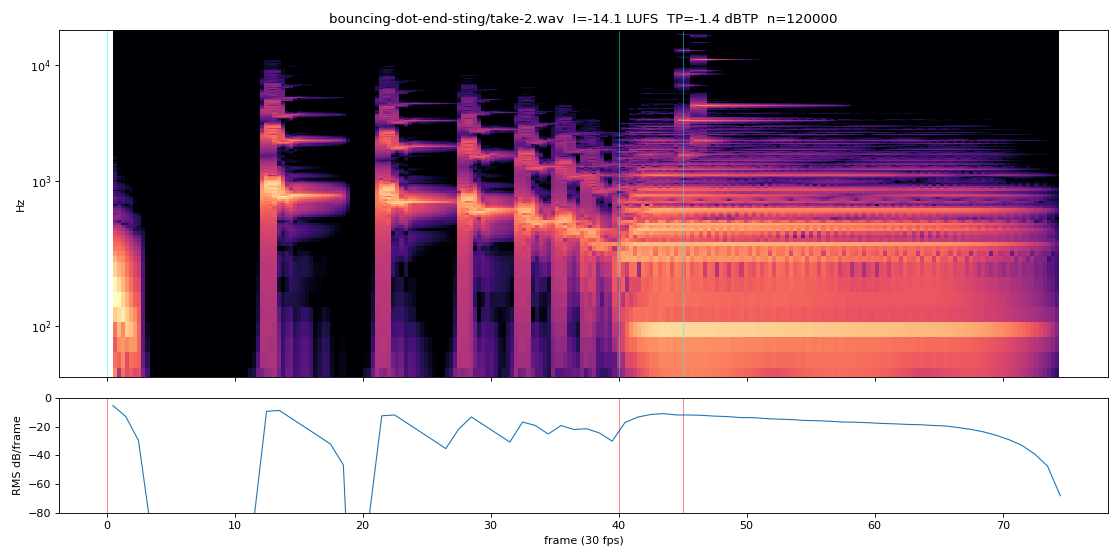
Output: one WAV, 48 kHz / 16-bit / stereo, exactly 120,000 samples (2.5 s at 30 fps = 75 frames). Python + numpy/scipy only. Synthesise everything (no samples, no downloads, no speech). Fixed random seed (np.random.default_rng(55)). A 2.5-second end-card sting for a motion-design outro, F# minor at 128 BPM. Frame 0: a single soft 'pop' arrival (sine 180→90 Hz, 60 ms, plus a 1 ms click). Then a ball bounces 6 times with physically decaying gaps (0.42, 0.30, 0.21, 0.15, 0.10, 0.07 s) and amplitudes (each 0.7x), each bounce a rubbery sine 'boink' with a fast upward pitch blip (+5 semitones in 15 ms then settle), pitches stepping F#5, E5, C#5, A4, F#4, C#4. When it settles (about frame 40) a warm F#m(add9) chord swells on felt-piano-like partials with a low F#2 sine, and a tiny glass sparkle on frame 45. Ring out to exactly 0 by the last sample. Mono-centred bounces, chord wide. Master: -14 LUFS integrated, true peak <= -1 dBTP (4x oversampled peak check), last frames fade to exactly 0. You can't listen, so verify: measure loudness and true peak with ffmpeg ebur128 (peak=true), check the exact sample count, confirm the energy change lands on each cue frame, check every note fits the chord under it, render a spectrogram PNG and inspect it. Fix and re-render until every check passes, then report the numbers.
Metrics
- Integrated LUFS
- -14.1 LUFS
- True peak
- -1.4 dBTP
- Length
- 2.5s · 120,000 samples @ 48000 Hz
- Target master
- -14 LUFS · peak ≤ -1.3 dBTP
- Checks
- Passed
Spectrogram
Generated code
Loading…Timing & cues
128 BPM · 30 fps · seed 56
- Frame 0: pop arrival
- Frame 40: chord swell
- Frame 45: glass sparkle
Six rubbery bouncing boinks with physically decaying gaps into a warm F#m(add9) swell and glass sparkle.
More like this
More free logo stings on the directory.