Space
Prompt
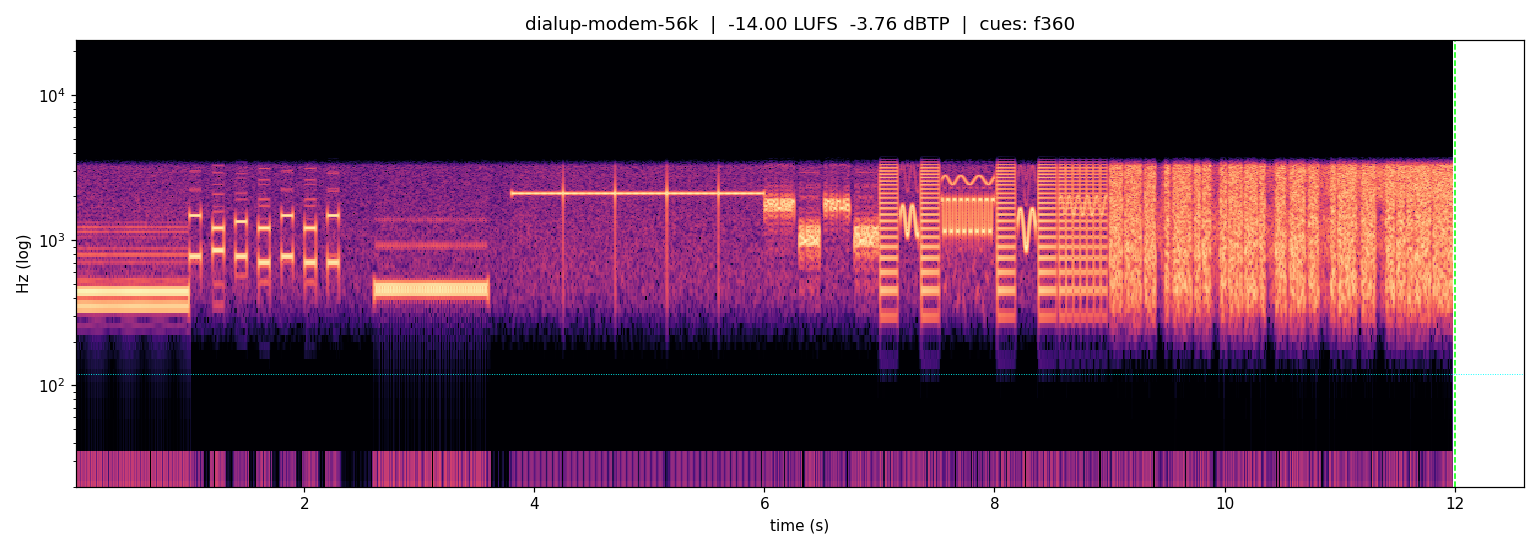
A 12-second 56k dial-up modem connection, 576,000 samples, 30 fps, everything band-limited to a 300-3,400 Hz telephone line with faint line hiss and slight 2nd-harmonic distortion. Timeline: 0-1.0 s off-hook dial tone (350 + 440 Hz); 1.0-2.4 s seven DTMF digits (standard row/column pairs, 100 ms tone / 100 ms gap); 2.6-3.6 s one ringback burst (440 + 480 Hz); 3.8-6.0 s answer tone 2,100 Hz with 180 degree phase reversals every 450 ms and 15 Hz amplitude modulation; 6.0-7.0 s V.21-style FSK bursts (1,650/1,850 Hz at 300 baud, random bits) answered by the other side; 7.0-9.0 s V.34-style line probing: a comb of tones every 150 Hz from 150 to 3,750 Hz with phase reversals (the "bong" chirps), then 9.0-12.0 s loud scrambled training noise in rhythmic bursts with a rising hiss, cutting to dead silence through a 3 ms fade ending exactly on frame 360 ("connected"). Mono-centred with slight width. Tame 2-3 kHz harshness.

Take angle 2 (gritty handset): same protocol timeline, heard through an old handset: carbon-mic-style nonlinearity, a slightly narrower line (400-3,200 Hz), a little 60 Hz-free crackle, and extra emphasis on the V.34 probing 'bongs' and the warbling V.8 / V.90 negotiation between 7 and 9 s; the training section is grainier with stuttering bursts.
Metrics
- Integrated LUFS
- -14 LUFS
- True peak
- -3.76 dBTP
- Length
- 12s · 576,000 samples @ 48000 Hz
- Target master
- -14 LUFS · peak ≤ -1 dBTP
- Checks
- Passed
Spectrogram
Generated code
Loading…Timing & cues
30 fps · seed 43
- Frame 360: connected (cut to silence)
Full dial-up timeline on a narrow 400–3200 Hz handset line: dial tone, seven decodable DTMF digits, ringback, a 2100 Hz answer tone with phase reversals every 450 ms, V.21-style FSK both ways, V.34-style 150 Hz-comb probing "bongs" with V.90 warbles, then grainy stuttering training noise. Carbon-mic nonlinearity and faint crackle; the training cuts to dead silence through a 3 ms fade ending exactly on frame 360. Take 2 of 3 (gritty handset), picked as the most "remembered" dial-up; the narrow line weakens the 350 Hz half of the dial tone by ~7 dB.